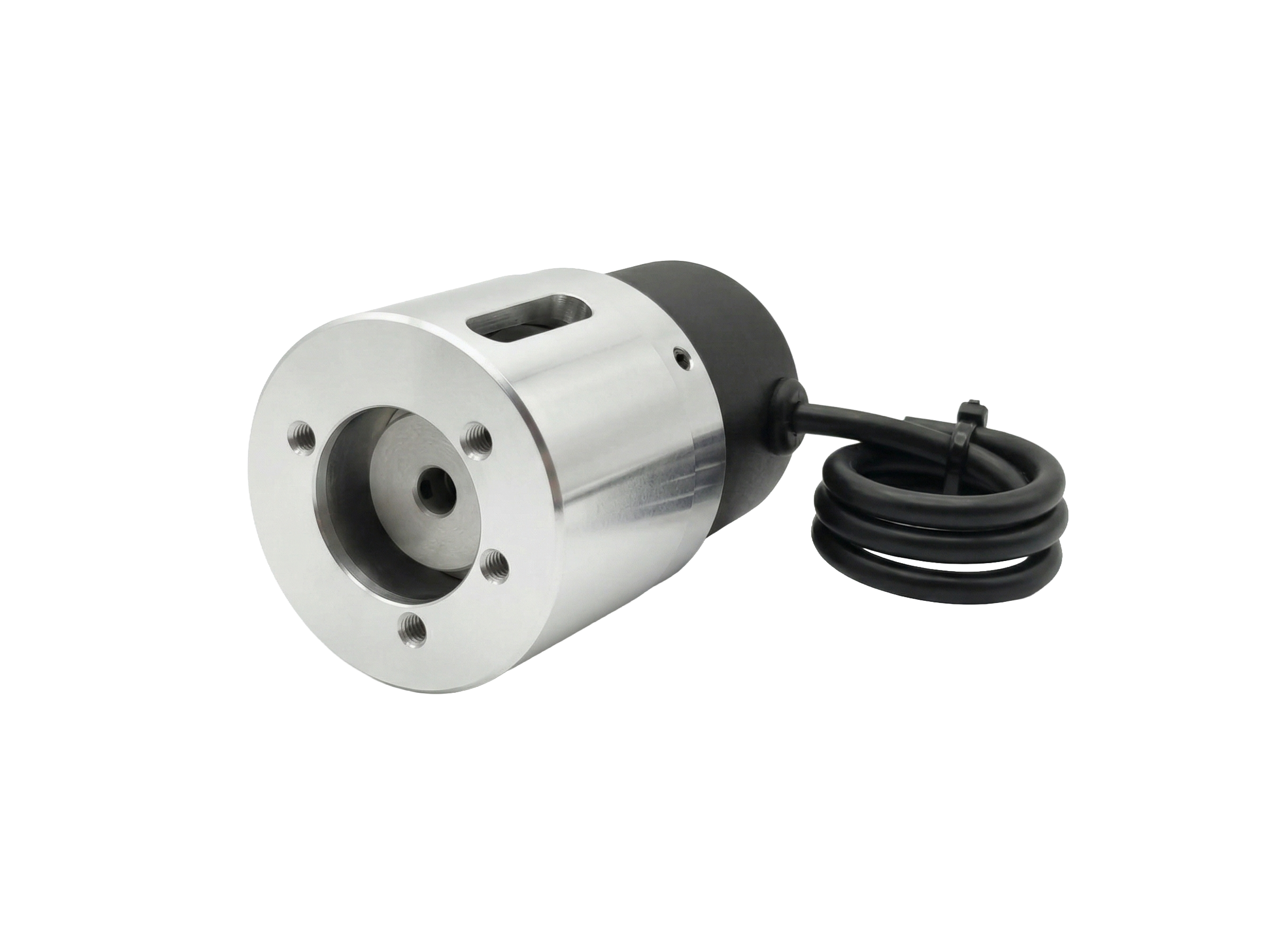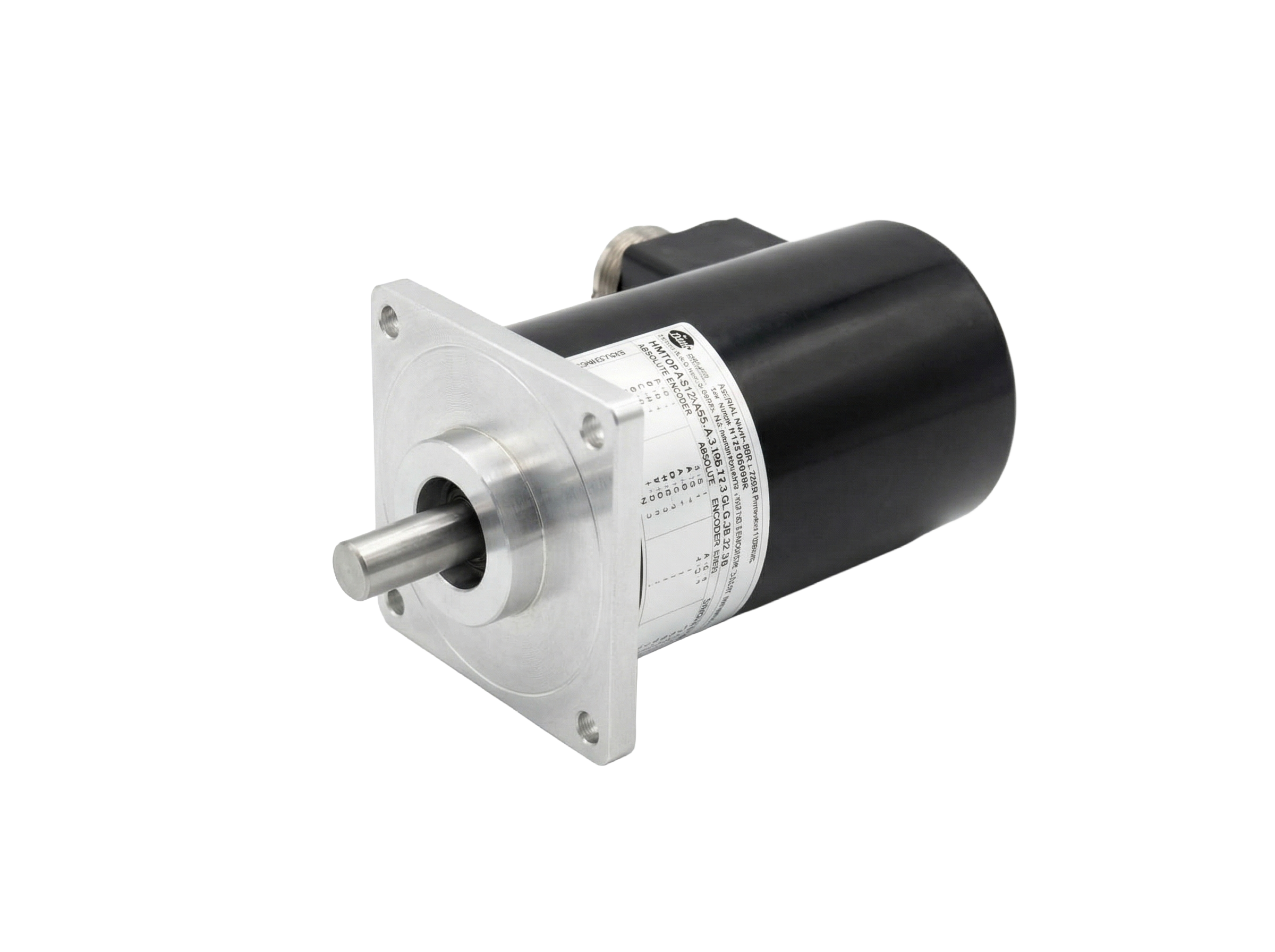
Magnetic Encoder: Working Principle
The magnetic encoder uses magnetism principles to detect angular position. Unlike optical, it is not sensitive to dust, oil, or condensation, making it ideal for harsh industrial environments.
Main Components
- Permanent magnet: a multipole magnet (typically ferrite or rare-earth NdFeB) is fixed to the encoder shaft and rotates with it.
- Hall or GMR sensor: Hall effect or magnetoresistive (Giant Magnetoresistance) sensors are positioned on a fixed PCB facing the magnet. They detect magnetic field variations during rotation.
- Processing ASIC: a dedicated integrated circuit interpolates raw Hall sensor signals to achieve high resolutions and generates digital outputs (incremental or absolute).
- Contamination resistance: dust, oil, condensation don't affect operation
- Extended temperature range: -40°C to +125°C (vs -10/+70°C for optical)
- Mechanical robustness: no fragile components like glass disks
- Compactness: simpler design, smaller dimensions
- Lower cost: for medium-low resolutions
- Lower resolution: typically max 8,192-16,384 ppr (vs 65,536 for optical)
- Sensitivity to external magnetic fields: motors, welders, transformers can disturb measurement
- Lower accuracy: typical error ±0.1° (vs ±0.01° for optical)
How It Works
The multipole magnet generates a magnetic field that varies sinusoidally during rotation. Hall sensors (typically arranged 90° apart) generate two sinusoidal signals in quadrature. The ASIC performs interpolation (typically 8x-256x) to multiply the magnet's base resolution.
For example: a 32-pole magnet with 64x interpolation produces 32 × 64 = 2,048 pulses per revolution.
Advantages of Magnetic Technology
Limitations
When to Choose Magnetic
Environments with dust (cement plants, sawmills), extreme temperatures (ovens, freezers), applications where required resolution is < 4,096 ppr.