EtherCAT: High-Performance Industrial Communication
EtherCAT (Ethernet for Control Automation Technology) is a real-time Ethernet communication protocol developed by Beckhoff Automation. It offers superior performance compared to any other fieldbus for motion control applications.
Working Principle
EtherCAT uses a unique principle called "processing on the fly":
- The master sends a single Ethernet frame through the network
- Each slave (encoder, drive, I/O) reads its own data and inserts its response into the frame WHILE the frame passes through it
- The last slave sends the frame back to the master
- A complete cycle for 100 nodes requires only ~100 μs
- Line (daisy-chain): each device has two RJ45 ports (IN and OUT). Ethernet cable passes from one to the next.
- Star, tree, ring: supported via EtherCAT switches or junctions
- Distance between nodes: up to 100 m with standard Cat.5e Ethernet cable
- Cycle time: < 100 μs for hundreds of nodes
- Jitter: < 1 μs (deterministic)
- Bandwidth: 100 Mbit/s (full duplex)
- Synchronization: Distributed Clocks (DC) with < 100 ns jitter between slaves
- Single-turn (13-bit) and multi-turn (14-bit) absolute position
- Internally calculated speed
- Configurable position preset
- Complete diagnostics (internal temperature, bearing status, errors)
- Distributed Clocks for multi-axis synchronization
- Simple wiring: single Ethernet cable for data + power (with EtherCAT P)
- Integrated diagnostics: each encoder reports its health status
- Remote parameterization: resolution, preset, direction configurable from PLC
- Industry 4.0: direct integration with SCADA and MES systems
- Cost reduction: no dedicated encoder cable, no SSI module in PLC
- Beckhoff TwinCAT: native integration
- Siemens S7-1500: via EtherCAT slave module
- Codesys: EtherCAT master runtime
- Linux: open-source EtherCAT master (IgH)
Topology
Performance
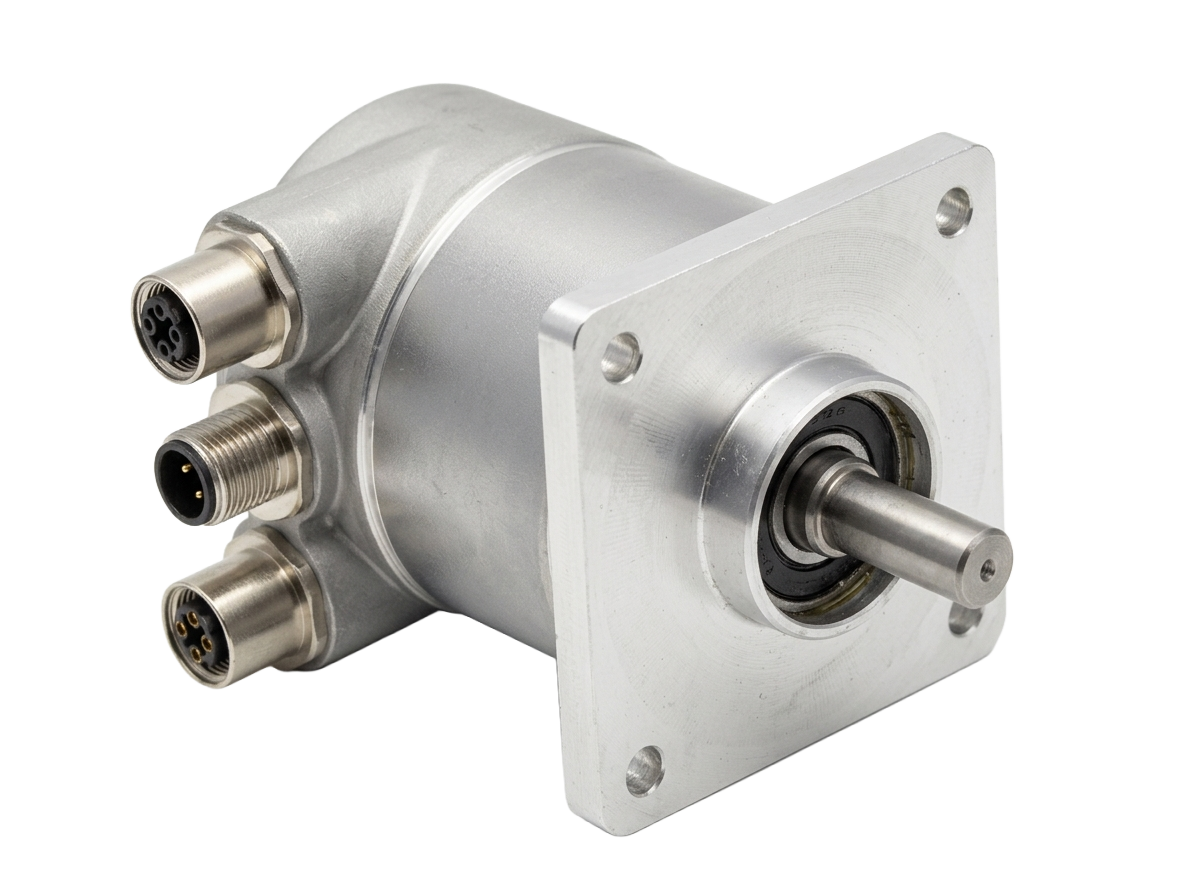
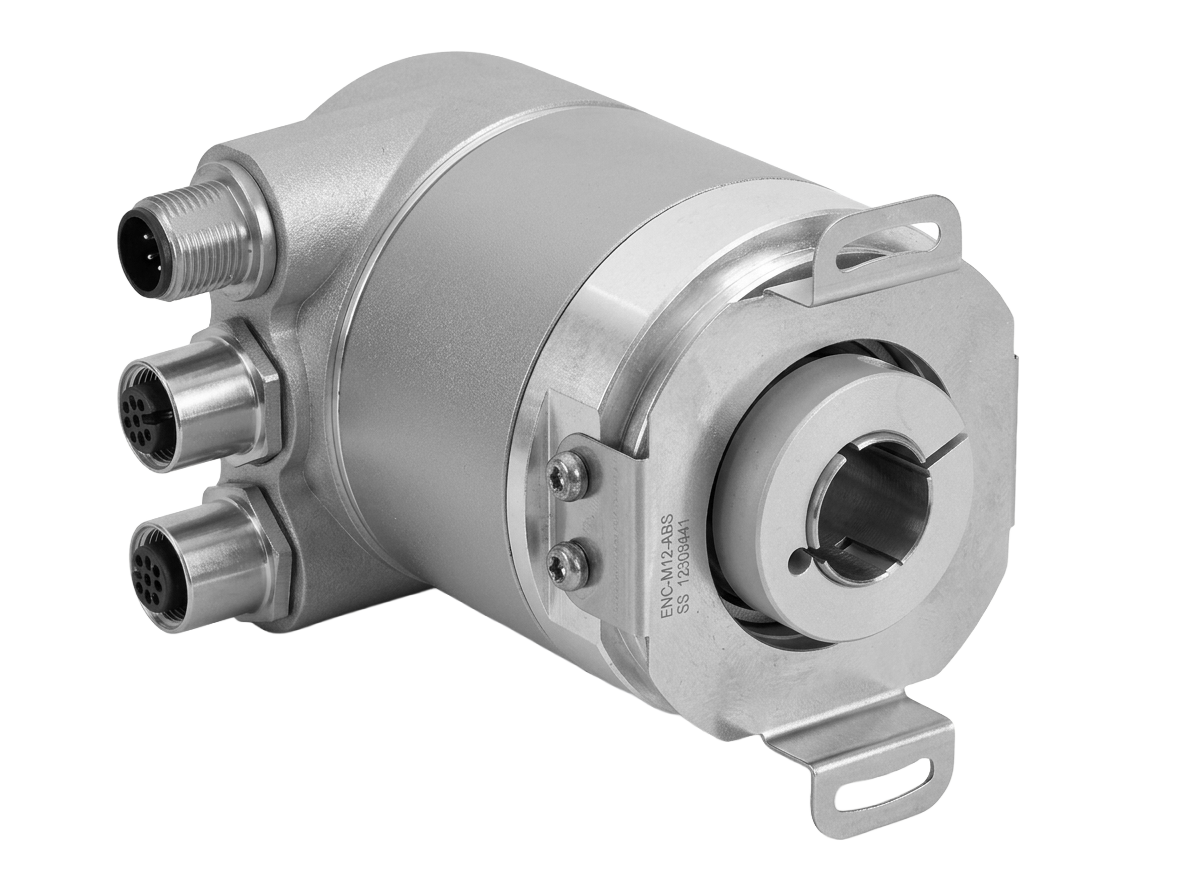
Italsensor EtherCAT Encoders
Italsensor encoders with integrated EtherCAT (TSM-ETHCAT and TSML-ETHCAT series) implement the CoE (CAN over EtherCAT) profile with: