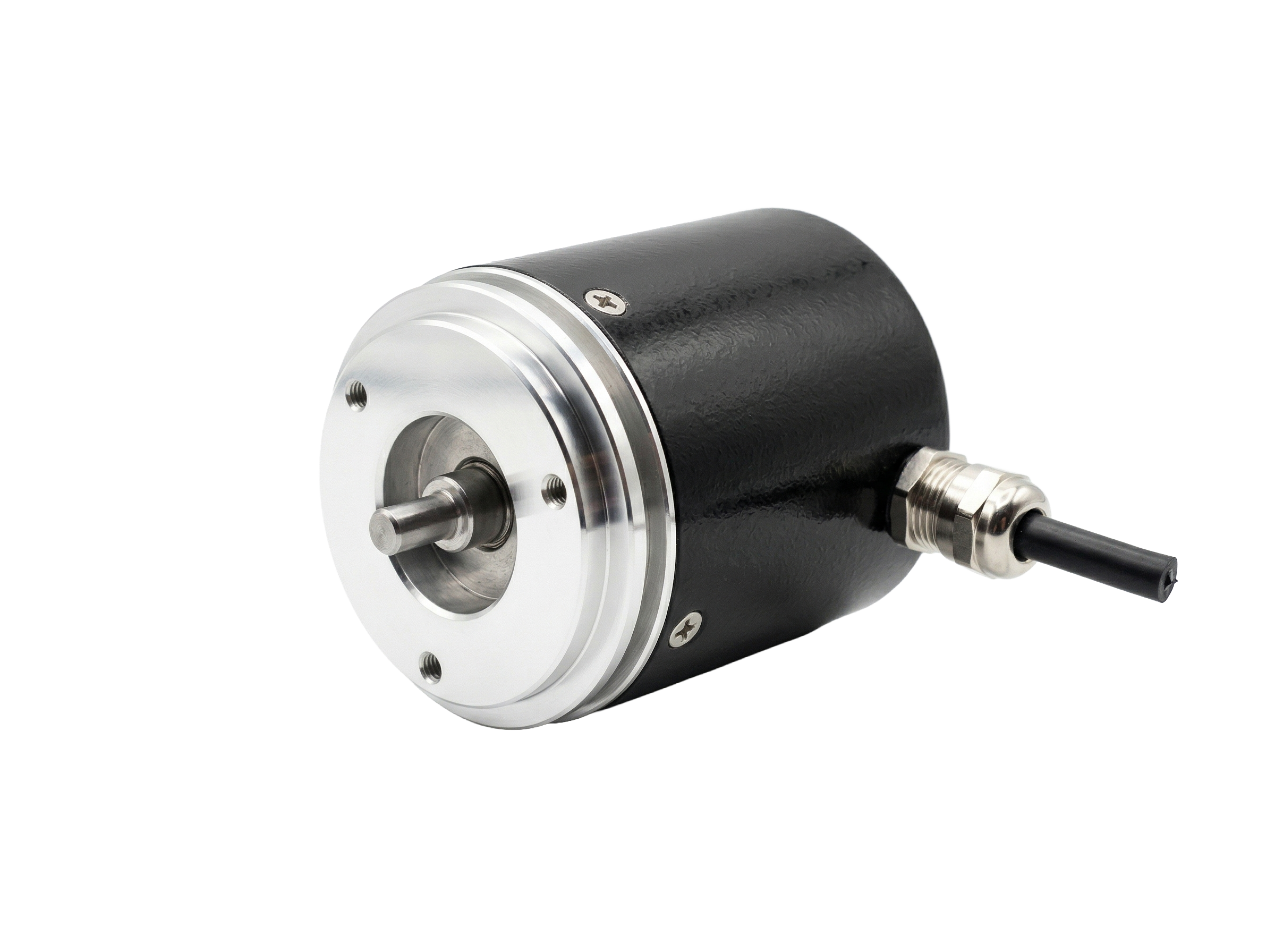
Solid Shaft vs Hollow Shaft: Selection Guide
The shaft type choice is determined by the mechanical application and mounting method. Each type has specific advantages and limitations.
Solid Shaft
The solid shaft encoder has a protruding shaft (typically Ø6, Ø8, Ø10, or Ø12 mm) that connects to the machine shaft via a coupling.
Advantages:
- Universal mounting with mechanical coupling
- Flexible coupling absorbs vibrations and misalignment
- Possibility of transmission ratios with pulleys/belts
- Suitable for very high speeds (>10,000 RPM)
Disadvantages:
- Requires axial space for the coupling
- Critical alignment — misalignment > 0.1 mm can damage bearings
- More complex mounting
Hollow Shaft
The hollow shaft encoder has a through-bore (typically Ø8-15 mm for standard encoders, up to Ø50 mm for heavy-duty) that slides directly onto the machine shaft. Anti-rotation is ensured by a pin or spring that prevents the encoder body from rotating.
Advantages:
- Direct mounting on shaft, no coupling needed
- No alignment issues
- Reduced axial footprint
- Quick installation (< 5 minutes)
- Ideal for axes with limited space
Disadvantages:
- Machine shaft must have the right diameter
- Lower maximum speeds (bearings with play)
- Vibrations and shocks transmitted directly to bearings
Through Hollow Shaft
Variant with the hole completely open on both sides. The machine shaft passes through the encoder. Used on long shafts that cannot be interrupted (e.g., transport rollers, transmission axes).
When to Choose
| Application | Recommended Type |
|---|---|
| Electric motor | Solid shaft + coupling |
| Gearbox/roller | Hollow shaft |
| Long through axis | Through hollow shaft |
| Speed > 10,000 RPM | Solid shaft |
| Limited axial space | Hollow shaft |
| Vibration environments | Solid shaft + flexible coupling |